AM & FM: The Secret Language of Radio Waves and How They Power Our World!
🌐 Imagine you’re at a concert. The singer’s voice (your message) needs to reach the back of the crowd. How? They use a microphone to amplify their voice. In the same way, AM and FM are “microphones” for radio waves, turning whispers into signals that travel across the globe!
Meet the Electromagnetic (EM) Spectrum: The Universe’s Superhighway
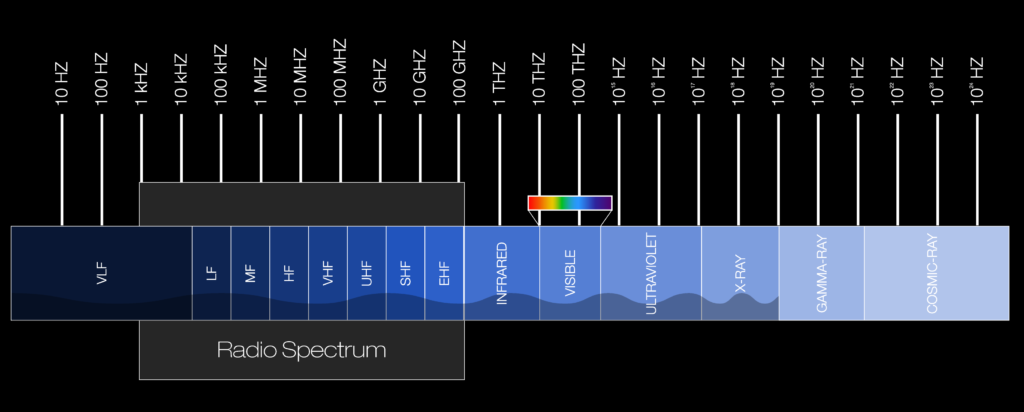
The EM spectrum is a cosmic rainbow of invisible waves, from gamma rays (tiny, high-energy ripples) to radio waves (giant, lazy ripples). Each type of wave has a unique superpower:
- Gamma rays: Destroy cancer cells.
- X-rays: See through your body.
- Visible light: Let you read this text.
- Radio waves: Carry music, Wi-Fi, and cat videos.
Modulation Magic
On the Electromagnetic Wave (EMW) Spectrum, a wide range of waves can be modulated to carry information. Modulation is the process of varying one or more properties (amplitude, frequency, or phase) of a carrier wave to encode data.
In simpler words, to send data, we “hitchhike” information onto these EM waves by tweaking their properties:
- AM (Amplitude Modulation): Change the wave’s height (like turning a flashlight’s brightness up/down to send Morse code).
- FM (Frequency Modulation): Change the wave’s pitch (like sliding your finger on a guitar string to make higher/lower notes).
AM vs. FM: The Battle of the Bands
AM Radio – The Old-School Storyteller
- How it works: Amplitude Modulation (AM) is a method of encoding information onto a high-frequency carrier wave by varying its amplitude (strength) in proportion to the instantaneous amplitude of a lower-frequency message signal (e.g., speech, music, or data).
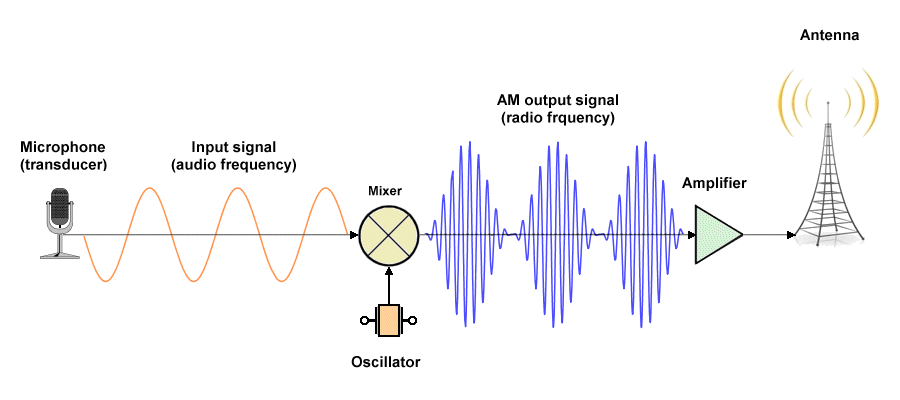
- Bandwidth: Needs only a 10 kHz “slice” of the spectrum (like a narrow bike lane).
- Why? AM’s simple “up-down” changes don’t need much space.
- Pros: Travels far (even across oceans at night using skywave reflection).
- Cons: Static! Thunderstorms or toasters can drown the signal.
FM Radio – The High-Fidelity Rockstar
- How it works: Frequency Modulation (FM) encodes information onto a carrier wave by varying its frequency (pitch) in proportion to the amplitude of the message signal (e.g., music or speech).
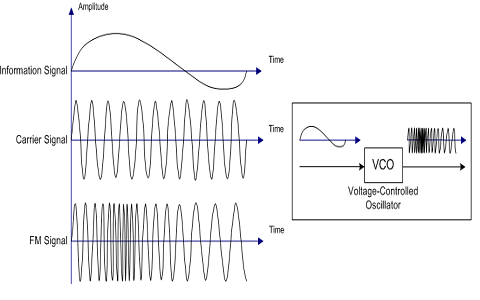
- Bandwidth: Needs 200 kHz (a wide highway lane).
- Why? FM’s wild frequency swings require more room to “dance” without crashing into neighboring stations.
- Pros: Crystal-clear sound, immune to noise (your microwave won’t ruin Ed Sheeran’s voice).
- Cons: Shorter range (line-of-sight only).
Why Bandwidth Matters: The “Real Estate” of the Airwaves
1. Bandwidth = Space for Data
- Analogy: Think of bandwidth as the width of a highway.
- A narrow highway (small bandwidth) can only fit a few cars (data bits) at once.
- A wide highway (large bandwidth) allows more cars to zoom side-by-side.
- Translation:
- AM Radio: 10 kHz bandwidth = A bicycle lane (good for simple voice signals).
- FM Radio: 200 kHz bandwidth = A four-lane road (great for music’s rich details).
- 5G: 100 MHz+ bandwidth = An 8-lane superhighway (for 4K streaming, VR, and more).
- Fun fact: The entire radio spectrum (3 Hz – 300 GHz) is just 0.0001% of the EM spectrum. Yet, it powers 99% of our wireless world. Physics is full of surprises!
2. Bandwidth Dictates Speed and Quality
- More bandwidth = More data per second.
- Example:
- AM Radio: 10 kHz → ~0.02 Mbps (enough for voice).
- Wi-Fi 6: 160 MHz → ~1.2 Gbps (enough for 50 HD Netflix streams).
- Example:
- High-bandwidth apps need room to breathe:
- Zoom calls: Need ~2–4 Mbps.
- 8K Video: Needs ~50–100 Mbps.
- Self-driving cars: Need ultra-low latency + massive bandwidth to process sensor data.
4. Trade-Offs: Bandwidth vs. Physics
Higher-frequency bands (like 5G’s mmWave) offer tons of bandwidth but come with quirks:
- Short range: Millimeter waves (24–100 GHz) can’t penetrate walls.
- Atmospheric absorption: Rain or humidity can absorb signals (like a sponge soaking up water).
- Solution: Engineers use beamforming and small cells to focus signals like laser pointers.
Radio Waves: The Invisible Heroes of Your Digital Life
Radio waves aren’t just for old-school radios. They’re the backbone of all wireless tech:
Wi-Fi (2.4 GHz / 5 GHz):
- Uses FM’s rebellious cousin: digital modulation (QAM, OFDM).
- Your router “sings” data in ultra-fast frequency hops, split into multiple lanes (channels) to avoid traffic jams.
- Fun fact: Wi-Fi 6 is like a “data Ferrari” – packs more info into the same bandwidth!
Cellular Data (4G/5G):
- 5G uses millimeter waves (24–100 GHz) – super-high-frequency radio waves with massive bandwidth.
- Why? To stream 8K VR, connect self-driving cars, and let you download a movie in seconds!
- Catch: These waves are divas – they can’t bend around buildings (need tons of tiny cell towers).
Bluetooth:
- A “mini-FM radio” in your ear! It uses frequency-hopping to dodge interference from microwaves or other devices.
Final Thought:
Next time you scroll Instagram or blast music in your car, remember: invisible waves are surfing through walls, air, and even you to make it happen. AM and FM are the OG rockstars of this show – and their descendants (Wi-Fi, 5G) are just getting started. 😎
Physics isn’t just equations – it’s the magic behind your screen! 🌟


Leave a Reply